

Story - Zongfei (Lisa) Yang
Championing disruptive innovation in fintech
A Quinlan professor's blockchain research—and new fintech class—are leading the way to breakthroughs.
Rapid innovations in the financial world—blockchain, cryptocurrency, NFTs, and increasing use of AI—have upended business as usual. Zongfei (Lisa) Yang, an associate professor of finance at Loyola University Chicago’s Quinlan School of Business, is helping business and her students navigate this relentlessly dynamic financial environment.
“There are lots of possibilities for disruptive innovations in the coming years,” Yang said. “To thrive, you have to be able to understand and keep up with fintech and finance.”
To that end, Yang created a new financial technology course for the Quinlan School of Business that is so cutting edge that there is no textbook available and she often has to revise her lecture notes right before class to keep up with breaking news in the sector.
“There is constant change in fintech,” she said. “I will get new information on something I am covering at the last minute, and I need to update my slides.” Zongfei (Lisa) Yang, Associate Professor
Building a cutting-edge fintech course
Yang’s Introduction to Fintech course is giving students a primer on the technologies that are reshaping the economy and the financial services landscape in real-time.
“My course augments our undergraduate courses in data analytics and AI, collectively providing a nucleus of knowledge and application in data sciences,” she said. “The course not only attracts finance BBA students, but also some other majors such as information systems, management, and marketing.”
Where brilliance meets purpose

Supply chain and the social good
Advancing food bank operations
Associate Professor Irem Sengul Orgut’s pioneering food bank research—and development of a new class, Analytics for Social Good—will help those in need.
Read about a new field for supply chain
Analytics and AI
At the intersection of AI and society
Assistant Professor Yuxiao (Rain) Luo is helping create guardrails for AI to benefit society through his research and courses.
Read about where data analytics meets ethics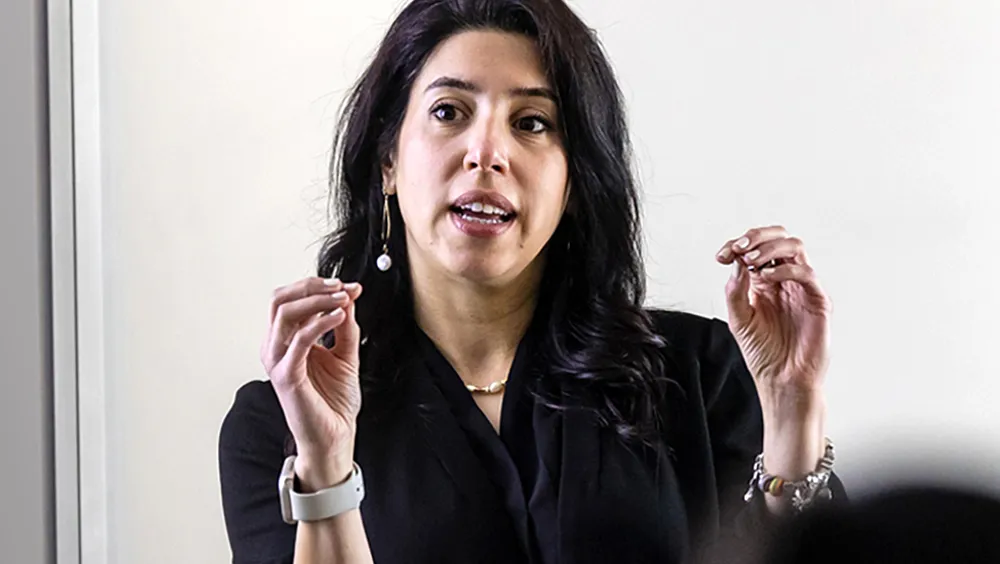
Digital Marketing and AI
Understanding trust in the age of AI
In an age of online misinformation, Associate Professor Shabnam Azimi is driving forward our understanding of how people process online information.
Read how AI impacts decision makingThe experiential impact of the course is enhanced by a mini-case competition sponsored and hosted by BMO. “It’s a boost for the student professionally and provides more motivation to explore fintech,” said Yang.
Applied learning with blockchain
Talia Lopresti (BBA ’26), a finance major, created an app for her course project that used blockchain to help musicians retain more earnings from their music online.
“I love music, and the project enhanced my understanding of the material in the fintech course because I was able to relate it to things that I was very passionate about.” Talia Lopresti (BBA ’26), a finance major and a regular DJ on Loyola’s FM radio station, WLUW
Lopresti and her team members built a platform where artists could showcase and sell their music. It uses blockchain to create a transparent ledger for secure payments and does not need a centralized third party to process transactions.
“The immutable ledger that blockchain provides means creators don’t have to use third-party platforms, which can take a large portion of their revenues,” Lopresti explained. “One argument against technology is that it can put a damper on creativity in various art forms. We wanted to apply fintech instruments to further enhance and encourage creativity and reward artists.”

Students dive into fintech in the Quinlan School of Business's Schreiber Center, which sits in the heart of Chicago.
Improving transactions through fintech
Yang’s research is focused on how fintech affects—and can improve—financial transactions, particularly for bond offerings and bond issuance in the primary market.
“One of the areas I'm interested in is whether security offerings through blockchain platforms would be more efficient. It would be an extension of a decentralized finance,” she said. Currently, investment banks are the middlemen in these bond transactions. The banks confer with the firms that would like to issue securities like bonds or stocks, then the banks talk to potential buy-side investors separately.
As Yang explains, the current set up creates an information asymmetry with an inherent market inefficiency that gives the investment bank a structural advantage. There is a great potential for cost savings in these transactions, says Yang, because the price of issuing the transactions can be quite high due to the lack of transparency.
“By using blockchain to decentralize the financing, you allow the issuer to provide information directly to their investors. Reduce the information asymmetry and you reduce the potential problems for the issuance agencies.” Zongfei (Lisa) Yang, Associate Professor
Yang suggests the same principle could be broadly applied, including to initial public offerings (IPOs). “We know IPOs normally sell at a much lower price than the secondary market price. So, if the issuing company can talk to their investors, that could remedy an asymmetry,” she said. “In this regard, some investment bankers are refashioning themselves in part as facilitators for these new opportunities, which will improve transparency in the market.”
Given the flood of disruptive innovations in the today’s fintech environment, Yang continues to innovate in the classroom and in her research. “You have to be able to stay ahead of the curve,” she said.